
.
“Political” art in the West
.
Early in the morning I headed to the Hamburger Bahnhof, where there was also a large section of the 12th Berlin Biennale of contemporary art, and step by step in this former station transformed for years into a mega avant-garde exhibition venue I was able to touch the current “political” state of art.
Those who wander around the 13,000 square meters (!) in reality find nothing other than what we already know through the media and the internet, videos of bombings, the documentation of various critical issues of the Third World (poverty, racial or gender discrimination), and then the migratory problems, torture (including, well hidden, the well-known ones made in the USA, done at home or around the world) and so on. Beyond this, the first (artistic) problem is that these “politically correct” themes that populate the exhibition are largely translated into banal “objects” which – as such – do not arouse any real reaction or empathy: miniminalistic cages , cardboard coffins, a piece of reinforced concrete found in the rubble of the bombings, and a myriad of “journalistic” photos such as those that clog up media and smartphones and that we no longer see, addicted as we are to all kinds of media images. As “objects” (without pathos, apathetic) are also the various aesthetic formalizations that we find there almost everywhere, like the gyroscopic frieze of a slice of sky that we discover (from detailed information and statistics displayed there) to be the Lebanese one crossed by raids Israelis, or the room with the walls entirely covered by a geometric grid drawn in pencil (an aseptic iron cage?), or the chromatic explosions and digital distortions that transfigure the image of unfortunates taken online …
In this (formal) aspect there is nothing new, because in these various “stylistic” solutions is at stake a process that has been underway since the 1960s, namely the emptying of the subject (and of its complex human and psychic charge) in favor of an art that – well before Covid time – promoted the “safety distance” between the work (or the world) and its author (or its viewer), instead of the subversive (and today more and more necessary) empathy … However, the most disturbing problem (and this should be for all these “political artists) is that the political-social denunciation is essentially directed beyond the borders of the West and never deals with what really happens within the borders of Europe (or of the” Far West “) : the catastrophes (for a large part of the population) created by neoliberalism and the financial system, the subjection of” democratic “governments to this criminal economic system, to arms manufacturers, or to pharmaceutical companies that – like the giants world of e-commerce and digital technology – have led (undisturbed) the Covid emergency in favor of their private interests. But it is not only this, what happens every day in our cities and homes, close to us, within us, also remains aside: violence against women and children, congenital and ever-present racism towards genders and foreigners, the reduction of workers’ rights and the increase of people in a state of poverty, the transformation of “citizens” into mere consumers, alienated and unconscious (and almost always dumbfounded in front of digital screens) … Not to mention the climate crisis, the great absentee, who should instead be at the center of the concerns of governments and everyone here on earth … and therefore especially of “engaged” artists, who if they really wanted to commit themselves would then have to address all these unspoken aspects – but perhaps it would be more useful to everyone that they decide to work in voluntary associations, or to be a journalist or war reporter, instead to make political art that seems useful only to them, to ride the wave, or to avoid engaging in the empathic arts of drawing and sculpture, and with empathy itself.
.
.
: Francisco Goya’s high street
.
On the same day, in the afternoon, I headed to the Berggruen Museum with the desire to review the works of some beloved masters, but I found the museum closed for renovation until 2025. Fortunately, next door, at the Sammlung Scharf-Gerstenberg, there it was a small exhibition dedicated to the Caprichos and Los desastres de la guerra by Francisco Goya …
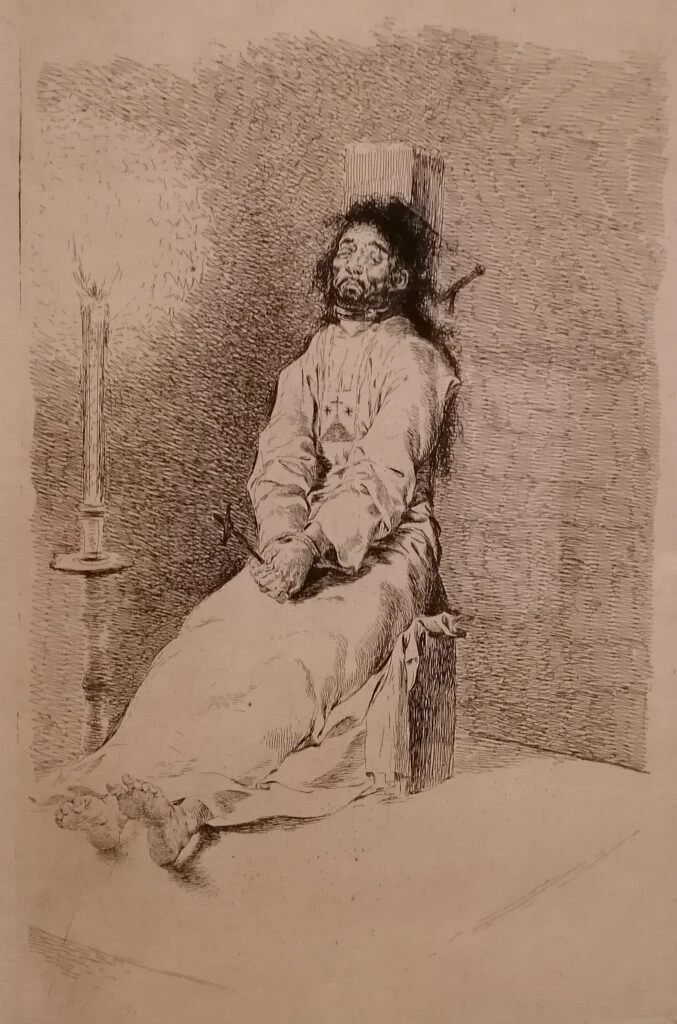
… Without looking for it (as it always should be, especially in an art world made up of preconceived intentions and concepts) the squaring of the circle appeared clear in front of my eyes … in fact, while in a small room shrouded in dim light I observe a woman locked up in prison “Because” (as the title states) “she was sensitive”, a tormentor who massacres defenseless and unarmed people (ironically called by Goya “What a Warrior!”), and then “The Garrotted man” (cruel murderous practice in use in Spain until the end of Franco’s dictatorship, 1975) with other engravings against the practice of torture, including the one under which Goya wrote “The Custody is as barbaric as Crime”, or the others by the Caprichos in which he lashes out against the clergy, the Inquisition and the social vices of his country … here, while I was reviewing all this, I remembered that three days after the “Lucientes” had put them on display in a grocery store (! ) located in a street from not a random name ( / Way of disillusionment), and on a particular day at the dawn of the new century (Ash Wednesday in 1799), the Royal militia seized them and removed from circulation. I could not fail to mention that the Desastres were able to begin to circulate, from niche to niche, only 35 years after the artist’s death, and that his now most important works (the engravings and the “black paintings” of the Quinta del Sordo) he – for many years the official painter of the Spanish Court – made them in secret and in hiding.
Here in Berlin, as in any other European kermesse, “political” art (which does not disturb anyone) is instead well-liked at the Court, as much of the other art (decorative, conceptual, pop and so on) is well-liked by the Market, blender that manages to blend everything, especially the vacuum. Especially if it is seasoned with a thousand vanities and conformisms and kept well isolated from real life as well as from the true awareness of the dramas of the world and of life itself which is mortal, and which for this reason would require sacred attention, a profound upheaval beyond the superficial foam which constitutes the world we have built and that submerges us if the act of conscience is not triggered in us that frees us and brings us closer to others, empathically, humbly, naked, like those who after the shipwreck know how to become children or timeless ancient beings.
Everyone crowds, especially the visual artists and various courtiers, on stages that do not exist, Mayan foam, cathedrals in the desert, Paths of Deception … just as the mass of artists of the last two / three centuries has been lost in the thousand veins of painting, in retinal art or on the contrary in “pure” art, but always in the folds of a purely formal or aesthetic, hedonistic, consolatory dimension …
.
The caves where the musician angels play
.
To Mika Akim and Julia Bilat
(and, of course, to Kirstin B. and Nicole W.)
.
What we can do, to lighten the world or the sky from its good false intentions, and ourselves, is to wander aimlessly, to lose ourselves, as Robert Walser or the Berliners Franz Hessel and Walter Benjamin have suggested … round the square then , rather than “squaring the circle”, thus relying on chance, which is then a constellation-flow mostly – from us – hidden … therefore, abandoning the ego and its vain attempt to schematize and exploit the world .. .
The day after visiting the Hamburger Banhof I discovered a lair, a cave, a refuge. Two thousand years ago it would have been called “catacomb”, in our years here in Berlin they called it “Haunt” (a word that includes the three above in italics). This quiet refuge and alternative art center is located next to Posdamer strasse (not far from where there was the infamous Nazi audodafè of books and “degenerate works of art”) and overlooks, as I discovered on arriving there, the Magdeburger Platz, a few meters from the birthplace where Walter Benjamin spent his childhood and early youth … the square (wandering without instructions) is once again rounded and without a net you can wake up, as happened to me in this place , suspended above a gravitational epicenter, above a space-time vortex …
.
Kirstin Burkhardt/Nicole Wendel’s video
.
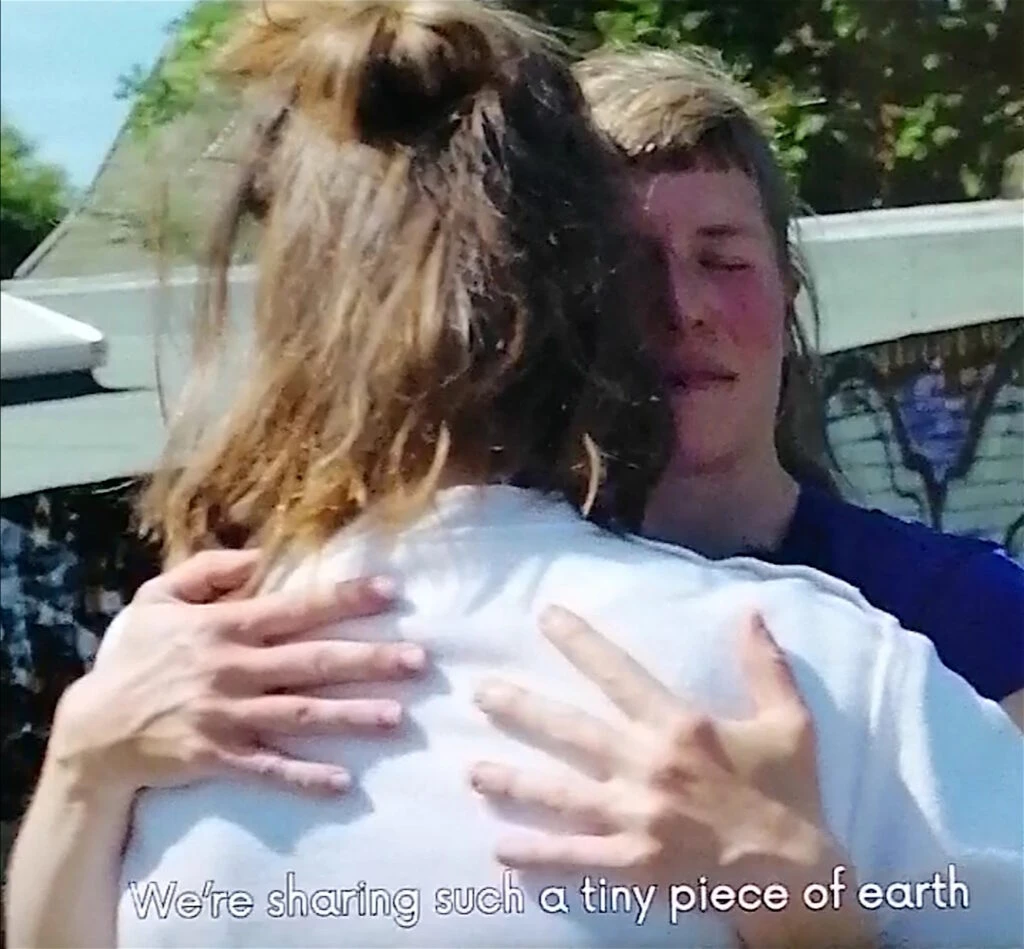
I rushed there attracted by the title of the exhibition-workshop by Kirstin Burkhardt and Nicole Wendel which alluded to a “real conversation”, which is not only the one between the two artists, a sign of their friendship, studded with words, signs and gestures that are launched or impress each other, but the similar constellation that here at the Haunt has involved visitors, in 45-minute sessions inside a room as if sealed. What they have experienced, first among themselves, then with visitors, is a form of “deep listening”, in which the contact of bodies and mutual listening can manifest themselves, the instinctive traces of the drawings born from dialogue, the fragments and wandering thoughts transcribed on the pages of a common diary. A practice that breaks the “safety distance” towards which they want to channel us (even in contemporary Salons); an artistic action that focuses on empathy, the real encounter between people, the idea of sharing – rare gems among the many who move (egocentrically and often relentlessly) in the art world, while while these “ancient ” values are mostly reduced to a sterile digital exchange for most of the inhabitants of the “civilized” earth. Theirs, however, is also a ritual, impregnated with grace, and therefore with beauty.
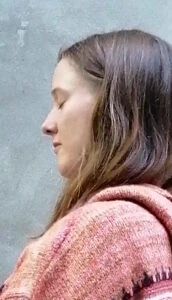
With in the eyes the blue cloth on which Nicole and Kirstin play by swinging a water bubble without letting it fall, in the “secret garden” of the Haunt a voice and a sound (those of Mika Akim) make that circle (that was square) rotate again… it is not only the grace and intensity of those Scandinavian sounds, the voice of the siderea Mika, that dissolves and re-establishes the fil rouge, but also the intensity, concentration and sharing that I saw on her face as she listened to the double bass player who introduced her concert. Visual artists would have a lot to learn from these musician angels, in which art is sharing, singing, a true common rite and the instrument they use, whatever it is, could be called “Viola d’amore” (like Mika’s one) …
Rather than then become bread for vampires (galleries, sales, public relations, utilitarianism, permanent connection, haste …), the possessed of the Salons could begin to be light, passionate and disinterested like these “tumbler”, like all the tumbler who bring the world into the world with song, dance and storytelling.
.
.
.
Mika Akim at Haunt, before her concert
.
.
.
The leaves, the hair, the water, the strings, the body, the clay …
.
“Follow the way of angels, not the way of vampires”. I don’t know why but when I woke up, and for the whole day, this phrase resounded in my head from I don’t know where. I had fallen asleep and woke up listening to the cd that Julia Bilat had given me, a dear musical angel found, after Rome, under the sky of Berlin. Armed with cello and voice.
Today I return to Italy. Outside, after clear days, it is raining. Beyond the windows, between three leaves and the road, the light is gray. The study of Sandra V. d. H., where I have been sleeping in these days, appears desolate after last night the works that with their primordial song, colored and powerfully, filled the room were gone.
The pieces of the cd I’m listening to are indicated with a single word: I read “drzewo” (tree), and then “mom”, “January”, “grandmother” … And so I understand that Julia’s is a genealogical tree, a constellation that draws a territory of proximity, a network of concrete relationships that empathically strive to break any distance. What is now extremely necessary.
Her hands touch the leaves, the hair, the water, the strings, the body, the clay. Like a refabetization, after having erased gradually, on one’s own skin, all the words that have been falsified. A starting step then. Barefoot, stained with mud.
So are the new angels moving on earth today?
.
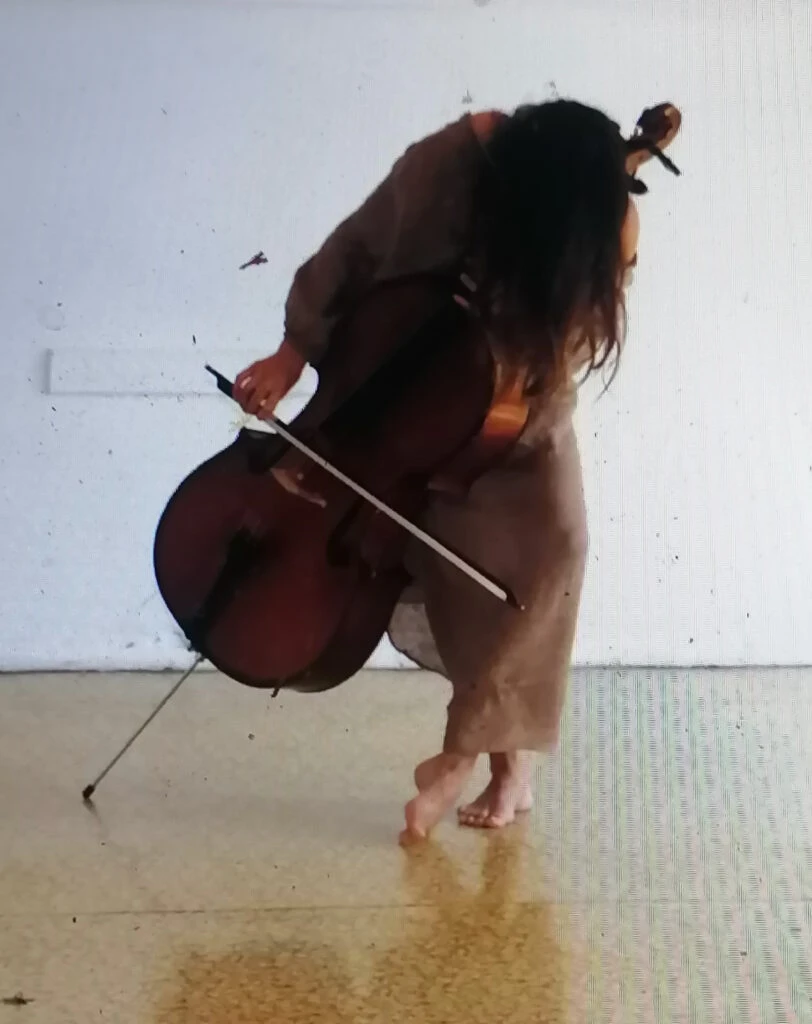 Julia Bilat
.
A.F., Berlin / Penna in Teverina, 4/11 September 2022